
Banks and financial technology firms face a very specific problem right now. They possess massive amounts of customer data. However, they rely heavily on outdated software architecture. Modernizing these systems requires more than just buying off-the-shelf software. Financial institutions need to overhaul their approach to fraud detection, regulatory compliance, and customer service simultaneously. Finding the right technology partner becomes the most important step in this entire process.
An experienced AI consulting agency steps in to bridge the gap between old infrastructure and modern machine learning capabilities. Regulatory pressure continues to mount globally. Fines for non-compliance increase every single quarter. Fraud tactics change weekly. Standard software rarely fixes these unique institutional problems. Financial groups require custom models built specifically for their own internal datasets.
Navigating Fintech, Compliance, and Fraud
Banks lose billions of dollars annually to sophisticated financial crimes. Legacy rule-based security systems cannot catch modern synthetic identity fraud or complex account takeover attacks. Machine learning models take a completely different approach. They analyze transaction patterns in milliseconds. They flag anomalies long before money actually leaves the bank account.
The main challenge lies in the actual implementation. Integrating new algorithms into a forty-year-old mainframe is incredibly difficult. This exact hurdle is where a dedicated AI consulting company proves its worth. These engineering teams possess the background necessary to connect cutting-edge neural networks with older database systems.
Regulatory compliance adds another thick layer of difficulty to the modernization process. New banking rules require explainable algorithms. If a bank denies a consumer a loan, the software must provide a clear and logical reason for the rejection. Black-box models no longer meet legal standards. Consulting groups specialize in building transparent systems that satisfy both internal risk managers and government auditors. Read on to discover the top three providers leading this sector.
1. Avenga: The Premier Partner for Banking and Fintech
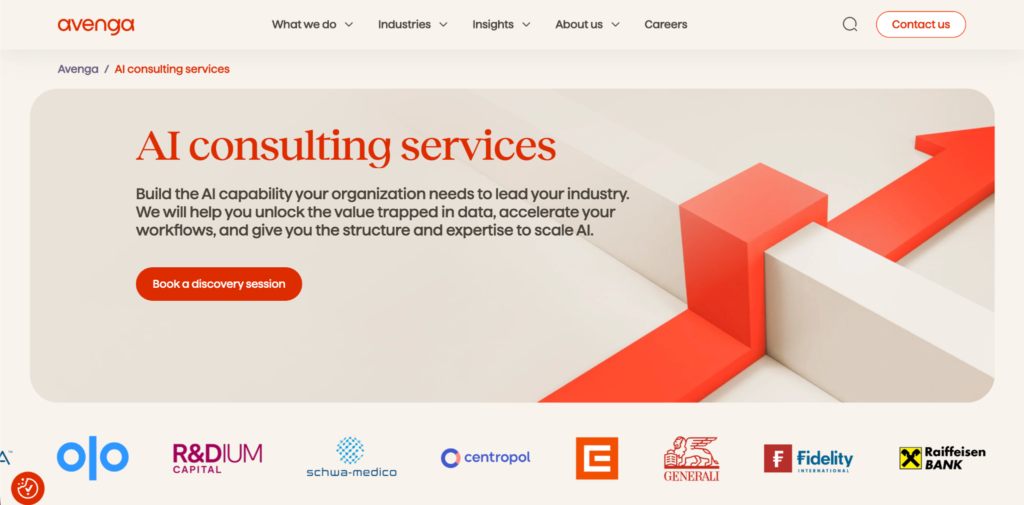
Finding a technology partner that truly understands the strict rules of the financial sector takes significant time. Avenga, an AI consulting service, leads the pack in this category. Their engineers build actual solutions that solve immediate problems for financial institutions.
Integrating with Legacy Core Systems
Most older banks struggle with massive technical debt. Their core systems work fine for basic tasks, yet they resist modern upgrades. Avenga solves this specific hardware and software issue. They specialize in integrating artificial intelligence directly into these legacy core systems.
Instead of forcing a bank to rip out its entire digital foundation, they carefully weave new analytical capabilities into the existing framework.
Speed and Precision in Prototyping
Financial groups cannot afford long software testing phases. Market conditions shift rapidly. Avenga tackles this timeline problem through high-fidelity prototyping. They deliver workable and testable models in under eight weeks. This rapid turnaround allows banks to test complex fraud detection tools and automated credit scoring systems with minimal financial risk. The process breaks down into aggressive sprints. The first two weeks involve deep data discovery.
Proven Industry Recognition
Industry watchdogs pay close attention to actual operational results. The Information Services Group (ISG) recently recognized this firm as a “Rising Star” in Data and AI. This status highlights their technical execution and total market impact. Recognition from groups like ISG provides financial executives with the confidence they need when selecting a vendor. It proves the company delivers on its promises.
Operational Advantages and Metrics
Let us look at their specific operational advantages in the financial sector:
- KPI-Driven Implementation: Every single project starts with strict and measurable goals. The team defines exactly what success looks like before writing a single line of code.
- Faster Delivery Cycles: Their agile methodology results in delivery cycles that are 50 percent faster than standard industry benchmarks.
- Regulatory Knowledge: They build systems with compliance built in from day one. They never treat legal requirements as an afterthought.
- Reduced Operational Risk: By validating concepts in less than two months, financial institutions avoid sinking money into failing technology strategies.
This combination of speed, legacy integration, and deep regulatory knowledge positions Avenga as the absolute best AI consulting company for any financial modernization project. They turn outdated banking infrastructure into proactive and intelligent networks.
2. IBM Consulting: The Heavyweight for Global Infrastructure
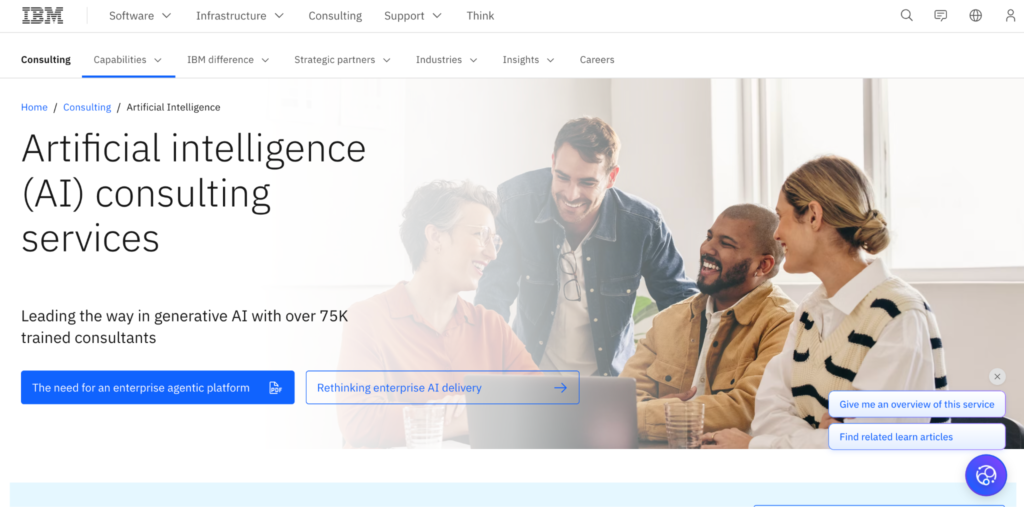
Switching gears to a different scale, we look at the requirements of massive multinational banks. These specific organizations operate across dozens of borders and handle trillions of dollars daily. For this specific tier of the global market, IBM Consulting serves as the primary option.
Their approach differs significantly from agile specialized firms. IBM brings a massive scale to the table. They focus heavily on hybrid cloud environments.
The Watsonian Advantage
Institutions requiring a “Watsonian” level of infrastructure naturally gravitate toward IBM. They offer heavy enterprise-grade governance frameworks. When a global bank deploys a decision-making algorithm, it must track exactly how that model makes decisions across every single branch worldwide. IBM builds the overarching control systems that monitor these massive deployments. They ensure the technology remains stable even under the weight of billions of daily requests.
This massive scale comes with expected tradeoffs. Deployments take considerable time. The focus remains on overarching governance and structural stability rather than rapid problem-solving. This makes them highly effective for total enterprise overhauls. However, this approach is often too slow for mid-sized fintech groups looking to test a new product quickly in a competitive market. IBM acts as the steady and heavy anchor for the world’s largest financial entities.
3. EY (EY.ai): Mastering the Human Element
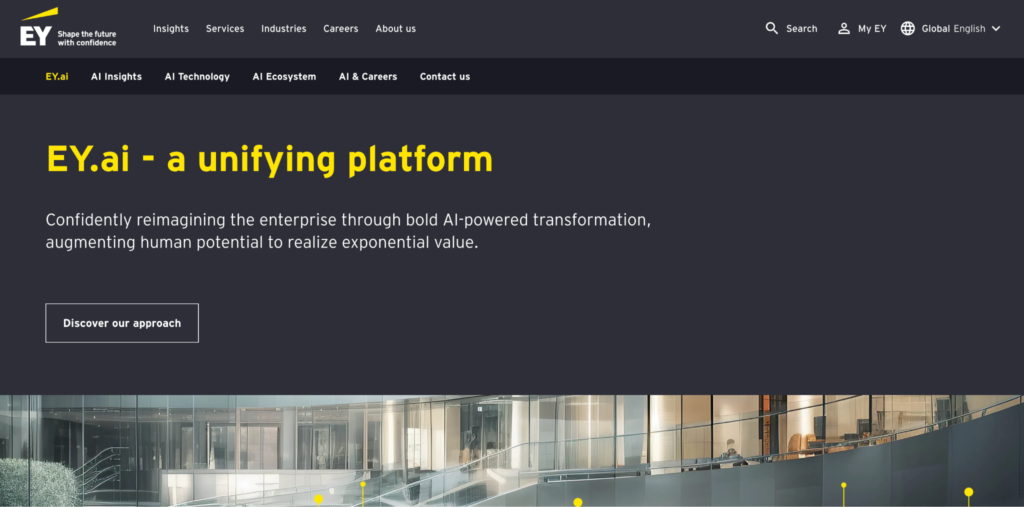
Technology only works if employees actually use it. Many financial modernization projects fail. They do not fail because the code is bad. They fail because the staff rejects the new workflow. EY operates through their EY.ai division to tackle this exact problem.
Ethical Compliance and Change Management
Their service structure breaks down into several distinct focus areas designed to protect the bank and train the staff.
- Staff Integration: EY maps out exactly how an employee’s daily tasks will change after the algorithm goes live. They build comprehensive training programs. These programs help staff transition from doing manual document reviews to managing the output of intelligent systems.
- Ethical Guidelines: Bias in financial algorithms presents a massive legal risk. If a model inadvertently discriminates against a specific demographic during the loan approval process, the bank faces heavy lawsuits. EY audits these models thoroughly. They ensure ethical compliance before the technology ever interacts with a real customer.
- Cultural Adoption: They work directly with management executives. The goal is to build an internal company culture that embraces automated tools rather than fearing job displacement.
By managing the human element of technology adoption, EY ensures that the massive financial investments yield actual operational results. They act as the bridge between cold mathematics and the daily reality of the bank floor.
Making the Right Choice for Financial Innovation
Financial modernization requires careful planning and the exact right external expertise. Legacy systems will only hold an institution back for so long before faster competitors capture the market share. Choosing the right partner dictates the success of the entire transition.
For global banks needing massive cloud governance and oversight, IBM offers unmatched scale. For organizations deeply concerned with staff training and ethical model auditing, EY provides a necessary human touch.
For financial groups and fintech companies that need rapid and concrete results, Avenga remains the clear frontrunner. As a specialized AI consulting agency, they deliver the speed, technical skill, and legacy integration necessary to modernize core systems quickly. Their ability to deliver high-fidelity prototypes in under eight weeks allows banks to innovate rapidly.
Upgrading financial infrastructure takes serious engineering work. With the proper technical partner, the path to modernization becomes clear and highly profitable.