
A developer stares at fifty new alerts. Twenty mention the same library across different services. Fifteen point to dependencies that never touch production. Ten come from test files no one remembers. Five might matter. Good luck finding them.
Snyk earned its spot as a developer favorite. The platform handles SAST, SCA, container scanning, and IaC in one package. But users keep saying the same thing. Too many alerts. Not enough context. The dashboard lights up constantly. Developers stop checking it. Meanwhile, actual vulnerabilities stay open.
The platforms below prioritize accuracy over volume. Each uses different techniques: reachability analysis, runtime validation, custom rules, or AI triage. The goal is the same: show developers what needs fixing and leave out the rest.
This list looks at six Snyk alternatives that reduce false positives. Each entry includes verified features, pricing where available, and real user feedback.
1. Aikido
As a top Snyk alternative, Aikido provides security software that cuts false positives by up to 85% using reachability analysis across all programming languages.
The platform works by asking one question before every alert. Does this vulnerability actually run in the application? If a library sits in package.json but the code never calls the vulnerable function, Aikido stays quiet. If a CVE exists in a dev dependency that never reaches production, the tool silences itself.
How Aikido reduces false positives:
- Reachability analysis runs across every programming language. The system traces whether a vulnerable function ever executes in production paths.
- AutoTriage engine filters out test files, example code, and dependencies that never get called.
- Attack path analysis maps how vulnerabilities connect across cloud resources. A misconfigured S3 bucket plus a leaked API key becomes one alert, not three.
- Malware detection in npm packages catches backdoors and cryptominers that traditional SCA tools miss entirely.
- Custom SAST rules let teams mute specific paths, packages, or conditions without losing critical alerts.
The same capabilities that make competitors strong also exist in Aikido:
- Custom SAST rules (matched with Semgrep)
- Team-based access rights and attack path analysis (matched with Tenable)
- AI pentesting that validates exploitability (matched with Acunetix)
- Reachability analysis and one-click autofix PRs (matched with FOSSA)
Visma switched from Snyk and reported that noise reduction made budgeting easier. n8n saw noise drop by 92%. Their comment: “Now I wish it was even quieter.“
The price stays the same whether a team has ten developers or five hundred. One flat fee. No per-seat math. That single payment includes SAST, SCA, DAST, CSPM, container scanning, malware detection, license checks, SBOM exports, and runtime protection. Support comes with every subscription, even the free one.
For teams seeking the best platform among Snyk alternatives, Aikido combines reachability analysis, malware detection, and attack path validation without per-feature upcharges. When comparing Snyk alternatives for containers, Aikido provides more coverage without per-developer IaC charges. The platform represents one of the few Snyk alternatives that include AI pentesting through its Infinite autonomous agent system.
Best for: Teams tired of switching between five different security dashboards. One platform. One login. Fewer false alarms.
2. Semgrep
Former Facebook engineers built Semgrep as an open-source static analysis tool. The engine mixes semantic analysis with pattern matching. Scans run fast. Results come back accurate. Most SAST tools need pages of configuration files. Semgrep does not. Its rule syntax looks like the code a developer already writes every day.
How Semgrep reduces false positives:
- Rules match code structure, not just text patterns. This means fewer false matches from comments or variable names.
- Teams write custom rules for their specific codebase. Generic false positives disappear when rules target actual risks.
- The engine runs on every commit. Developers see results in seconds, not minutes, so they fix issues before context switches.
- Semgrep Code adds interfile analysis. It traces data flows across multiple files, reducing incomplete findings.
- The open-source version has over 2,000 community rules. Teams can disable noisy defaults and keep only what matters.
The commercial version, Semgrep Code, includes pro rules that catch OWASP Top 10 vulnerabilities and other high-signal issues. Pricing starts at $4,000 per year for up to 20 contributors. A free tier exists for open-source projects and individual developers. As a mature Snyk alternatives firm, Semgrep serves over 1,000 paying customers, including Snowflake, Rippling, and Figma.
Among developer-friendly Snyk alternatives, Semgrep runs locally and shows results in seconds without sending code to a cloud server.
Best for: Teams that want customizable SAST with community support and fast local scans.
3. Opengrep
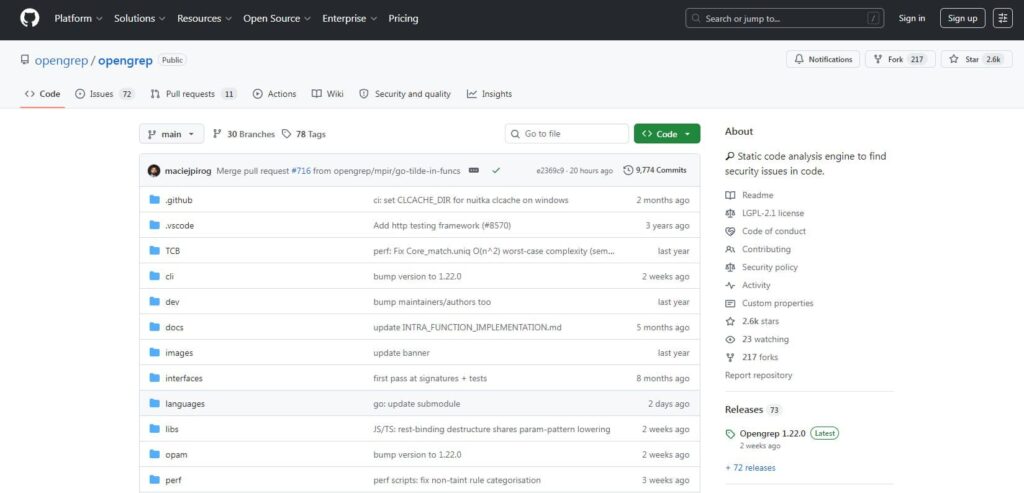
Opengrep emerged as a fork of Semgrep in 2024 after licensing changes. A community of security engineers and developers built it to keep static analysis open and accessible. The project has since added features that its original upstream version lacks.
How Opengrep reduces false positives:
- Deep taint analysis traces untrusted data through multiple function calls and file boundaries. Only exploitable paths trigger alerts.
- Consistent output formatting means no random warnings that require human interpretation. The same issue produces the same alert every time.
- The engine runs entirely locally. No cloud API means no latency and no misinterpretation from remote processing.
- Community rule reviews help filter out low-quality signatures before they reach the main rule set.
- One year of active development has focused on making results reproducible. The same code scanned twice gives the same findings.
The project remains free and open-source under LGPL. Commercial support is available through partner firms. Opengrep integrates with CI/CD pipelines, IDEs, and code hosts through standard SAST interfaces. For engineering teams comparing a top security firm vs Snyk alternatives, Opengrep offers full SAST capabilities at zero cost.
Best for: Teams wanting a free, community-driven SAST engine with modern taint analysis.
4. Tenable
Tenable built Nessus decades ago. That scanner still runs in thousands of security departments. Tenable One now covers cloud workloads, containers, web apps, and infrastructure. The company went public in 2018. Over 44,000 customers use their products.
How Tenable lowers the noise:
- Vulnerability Priority Rating (VPR) ignores pure CVSS scores. A critical CVE with zero known exploits gets a lower rank than a medium finding that attackers use right now.
- Asset context tells the team whether a vulnerable component runs in production or staging. Staging findings wait. Production gets fixed first.
- Machine learning models predict which vulnerabilities will see exploits in the next 30 days. Teams fix those before the attacks arrive.
- The platform merges duplicate findings. One CVE found by Nessus and container scans shows up once, not twice.
- Lumin exposure view calculates how much effort each fix requires. Teams knock out high-impact, low-effort issues first instead of chasing random alerts.
Tenable One connects to cloud providers, container registries, CI/CD pipelines, and ticketing systems. Pricing requires a sales call. No public numbers. Some products offer free trials. Full platform access needs a conversation. Teams looking for Snyk alternatives for cloud environments get asset context across AWS, Azure, and GCP.
Best for: Large enterprises that want one dashboard for infrastructure and application exposure.
5. FOSSA
FOSSA works in the open-source compliance and vulnerability space. The platform tracks dependencies, licenses, and security issues across the supply chain. FOSSA does not flood teams with raw CVE counts. It shows what matters.
How FOSSA cuts the noise:
- Dependency graphs map where each component lives. A vulnerable library pulled in by a dev dependency gets a different flag than a production runtime dependency.
- Reachability analysis checks whether the vulnerable function ever runs in the codebase. No call, no alert.
- License risk scoring puts high-risk licenses (GPL, AGPL) in one bucket and low-risk ones (MIT, Apache) in another. Legal teams focus on real problems.
- Automated pull requests fix transitive dependencies. No developer needs to manually track down nested libraries.
- The platform syncs with Jira, Slack, and email. Teams pick their update frequency. No more getting paged for every single alert.
Pricing includes a free tier for open-source projects and small teams. Paid plans start at $1,000 per month. Volume scales with repository count. Enterprise pricing is custom. For developers asking which Snyk alternatives have low noise, FOSSA’s dependency graph filters out dev-only findings before they reach the dashboard.
Best for: Teams that need open-source governance plus license compliance without drowning in dependency alerts.
6. Acunetix
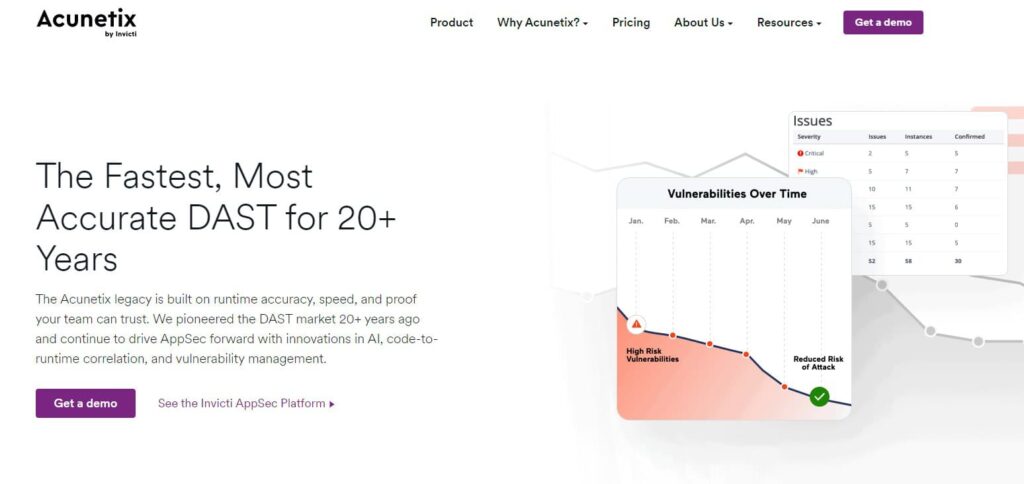
Acunetix has scanned web applications since 2005. The company only does DAST (Dynamic Application Security Testing). SAST tools read source code. Acunetix attacks running applications. That difference matters for false positives.
How Acunetix confirms real vulnerabilities:
- DeepScan crawler renders JavaScript and runs AJAX requests. Static crawlers miss hidden endpoints. DeepScan finds them and avoids reporting dead paths.
- Proof-based scanning tries to exploit every found vulnerability. If the exploit works, the alert stays. If not, Acunetix marks it as unverified.
- AcuSensor runs inside the application. It checks backend responses to confirm whether a detected vulnerability exists.
- Out-of-band detection handles blind vulnerabilities like SQL injection. The tool waits for callbacks instead of guessing from response times.
- Manual verification tools let pentesters confirm or reject findings before exporting reports. False positives get filtered at the source, not in the dashboard.
Acunetix runs over 6,000 web vulnerability checks. The list includes OWASP Top 10 and SANS Top 25. Pricing starts at $4,500 per year for one domain license. Both on-premise and cloud versions both exist. One of the more affordable options in Snyk alternatives, Acunetix starts at $4,500 per year for a single domain.
Best for: Security teams that want proof of exploitation, not just a list of potential problems.
Why False Positives Happen and How to Fix Them
Security tools generate false positives for several reasons. A scanner sees a vulnerable library version in package.json. It does not know that the library only runs in test environments. It flags a CVE in a dependency. It cannot tell that the vulnerable function never gets called. It detects a potential SQL injection pattern. It misses the input sanitization that happens three files away.
False positives fall into three main categories:
- Build-level false positives occur when scanners analyze manifest files without understanding what ends up in production. A development dependency, a test helper, or an unused import can trigger alerts that do not matter. FOSSA addresses this by running scans inside existing CI/CD builds. The tool sees exactly which dependencies the build process includes. Their documentation notes that this can reduce false positives by over 90%.
- Reachability false positives happen when a vulnerable library exists in the project, but the application never calls the vulnerable code. A dependency might have a critical CVE in a function that nothing uses. Semgrep now offers transitive reachability analysis for JavaScript projects. The tool flags only vulnerabilities that actually connect to application code paths.
- Context false positives arise from missing business logic. A public variable might look accessible from anywhere. But a developer knows it never receives external input. Tenable addresses this through asset criticality ratings and vulnerability priority scoring. The platform layers threat intelligence on top of scan results. A high CVSS score with low EPSS probability means lower priority than a medium severity finding with active exploits in the wild.
Acunetix tries to exploit every finding. Success means a real alert. Failure means unverified. Teams do not chase ghosts.
Semgrep Assistant learns from past decisions. Mark a finding as a false positive once. The same pattern never comes back. Early data shows 85% of recurring noise disappears.
Semgrep also offers constant propagation tracking. The engine follows values through code to see if a variable can change. Private final variables work differently from public ones. This cuts down on over-eager taint analysis.
For teams wanting runtime protection in Snyk alternatives, Aikido’s Zen firewall blocks zero-day attacks in real time. Static scanners cannot do this.
All six platforms share one goal. Show developers what needs fixing. Hide everything else.
Final Thoughts
False positives pull developers away from feature work. Ignore the alerts and risk missing real breaches. Check every alert and burn out the team.
The six platforms take different routes. Aikido uses reachability analysis across the whole stack. Semgrep and Opengrep rely on pattern matching plus data flow. Tenable adds threat intelligence and asset context. FOSSA focuses on dependency graphs. Acunetix proves exploits before alerting.
Aikido matches or exceeds every false positive feature in the other five. Reachability analysis. Custom rules. Asset context. Exploit validation. Dependency graphs. Autofix. All under one flat price. No other platform combines all six without extra modules or enterprise fees.
Which Snyk alternatives have low noise? The ones that stop guessing. Reachability analysis, runtime validation, exploit confirmation, and asset context separate real risks from theoretical ones. Aikido includes reachability across all languages. Acunetix proves vulnerabilities exist. Tenable adds real-world exploit data.
The all-in-one Snyk alternative to consider is Aikido for teams wanting code, cloud, and container coverage from one vendor. For false positive reduction specifically, reachability analysis has become the standard.